Blog
The Mechanics of Current Fashion Trends and How to Engage with Them|yutaka

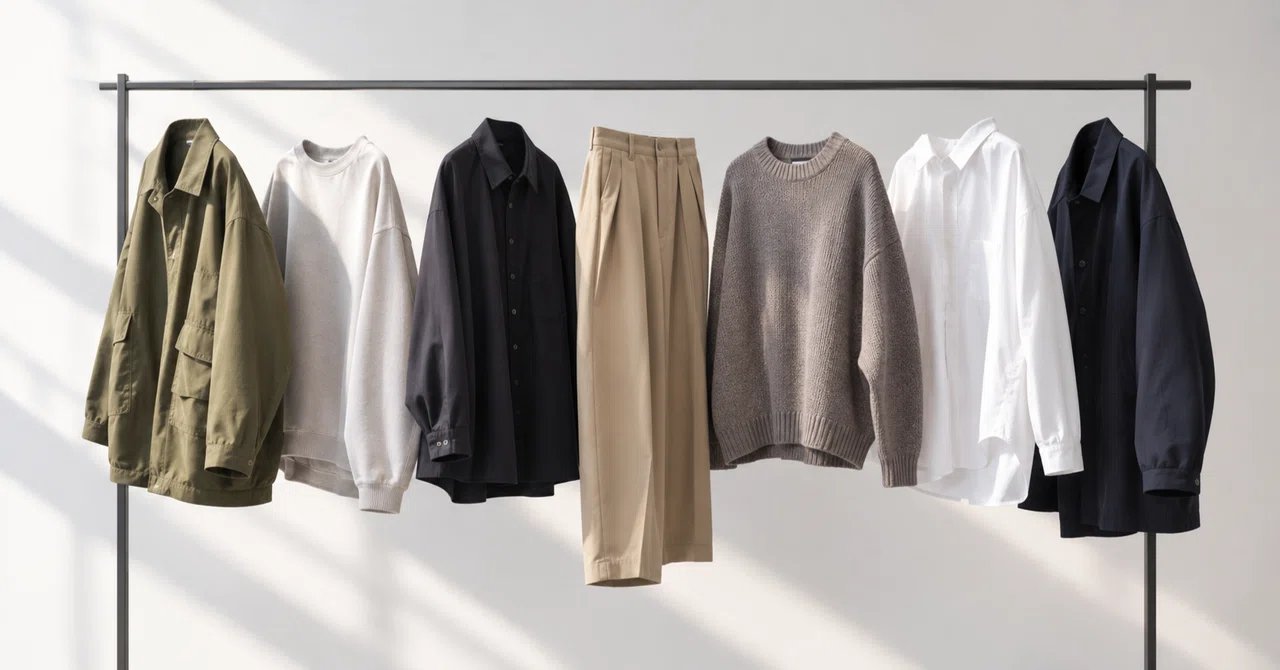
Over the past few years, the
oversized silhouette
has become completely established.
Loose tops with loose bottoms.
Dressing in a way that keeps the overall silhouette large is no longer anything special.
“It is no longer anything special.”
Once this becomes a shared sentiment for many people,
fashion trends
begin to show subtle changes.
From an extremely large sense of scale,
to a more regular size that follows the body a bit more.
Outfits with compact tops
while keeping the bottoms loose
have become relatively common to see.
When a long-standing trend
starts to change little by little like this,
you start to wonder
what kind of styles will increase next.
This time, I would like to think about
such changes in trends.
When we think of fashion trends from a while ago,
there was an image that they were sent out by famous brands,
starting with the fashion houses in Paris, London, and N.Y.
In fact, in the fashion industry of the past,
colors were decided two years before hitting the market,
then materials and fabrics were decided,
and from there, each brand would plan its products—
that was the kind of flow that existed.
Of course, even back then, trends were born from various places,
such as the styles of people on the street and youth culture.
Even so,
it is certain that the fashion houses held great influence.
However, today, compared to the past structure of
“fashion house dominance,” things have become quite complex.
The speed from product planning to production and sales has increased,
fast fashion has emerged,
and more brands have shortened the time
it takes to reflect trends in their products.
Furthermore, with the spread of social media,
not only brands and designers,
but also influencers and ordinary people
have become able to broadcast trends.
A style posted by someone
can spread all at once through social media.
In other words, current trends
appear to be shaped while becoming complexly intertwined
between various broadcasters and the people who receive them.
Now, why do trends
change in the first place?
For one thing, we can consider the circumstances
of the side providing the products.
For example, when oversized clothing becomes widely popular,
the frequency of new purchases and replacements drops.
If many people start wearing similar clothes,
brands will want to stimulate purchasing desire
with the next new product and lead to sales.
On the other hand, there are also reasons for change on the consumer side.
If the social atmosphere, living environment, and values change,
the clothing sought also changes.
For example, there are times when relaxed comfort is preferred,
and times when a clean look or
a neat impression is required.
Also, people might simply get bored of what they are used to seeing
and want to try wearing something different.
Brands make new proposals, and consumers accept them.
Seeing the consumers’ reactions, brands think about the next product.
This cycle of trend changes
has become more pronounced in the modern era,
where the speed to commercialization has become faster.
So, what will happen to
silhouettes from here on out?
First of all, it is already said that things are
changing toward a tighter direction.
What can be seen even now, in particular,
is styling that creates a difference
in the volume of tops and bottoms.
For the past few years, loose-fitting
I-line silhouettes have been prominent for both tops and bottoms.
In contrast, it seems that A-line silhouettes,
which feature relatively compact tops and voluminous bottoms,
are starting to spread.
Those who were comfortable with the previous tight-fitting trend
might immediately wonder if we are returning to the heyday of slim-fit styles,
but such changes happen slowly.
It seems to be starting with a shift in balance,
adjusting the sizing of tops while keeping the bottoms loose.
On the other hand, oversized clothing may continue
to maintain a certain presence.
Now that buying clothes online has become common,
the fact that it is easier to purchase clothes online
that are easier to wear even if the size is slightly off,
compared to clothes that require a precise fit,
is likely to have an impact.
For brands as well,
the loose sizing of oversized items
may be easier to handle
when planning products and aiming to sell them out.
In any case, changes in trends
do not mean that past trends disappear completely
and are replaced by entirely new things.
People who find that oversized styles
fit their personal style
will continue to wear them, and
there are also those who are looking forward to new trends.
Furthermore, there are even people who like
styles from long before those trends
and continue to wear them.
In this way, trends shift
while several tendencies coexist.
That said, when you hear that trends are changing,
you might feel like you have to stop wearing the clothes you have been wearing
and replace them with new trendy clothes.
However, as mentioned earlier, everyone has their own
preferences and style, so
there is no need to conform to trends that much.
But, a point to note here is that
even if you try to put the phrase “don’t follow trends, just wear what you like” into practice,
it is actually a bit difficult.
If you actually go to a store
or browse an online shop,
the clothes on display
are almost certainly reflections of the current trends.
Especially for those who are not used to fashion
and are just starting to enjoy it,
finding clothes based solely on their own preferences
regardless of trends will likely not be easy.
In other words, I think the realistic starting line
is to first try choosing items that suit you
from the clothes currently being sold.
Even with the same oversized clothes,
the shoulder width, length, and body width differ by brand.
The impression also changes
depending on the color, material, and fine details.
If you compare products from several different brands
online or in-store,
you should find that even clothes incorporating the same trend
can look quite different.
If possible, it is best to try them on in the store.
Which balance suits your body type and vibe?
What colors or materials are you drawn to?
If you keep these things in mind
and try on as many as possible before choosing,
you should start to understand the fun of choosing clothes.
And when trends change a few years later,
you can choose what suits you from among them again.
If you keep choosing repeatedly like that,
before you know it,
common points in the colors, silhouettes, and materials you prefer
will naturally start to appear,
even if only little by little.
Your own style
is not something you can define from the start.
It changes with your lifestyle, changes in your environment, age, and so on.
In the fashion advice I provide, in particular,
for those who have begun to see
how to enjoy fashion and what their own style is,
I tell them, “There is no need to force yourself to follow trends.”
The most important thing is your own personal style.
I tell them that it is enough to use trends
only as a “modern touch” for your own style.
So, first, know the trends,
and try choosing from them in your own way.
I think that repetition
is one of the classic ways to enjoy fashion.
If you are thinking of buying something for this season’s winter clothes,
why not try choosing with this perspective in mind?